Prism Photography:
The Complete Guide
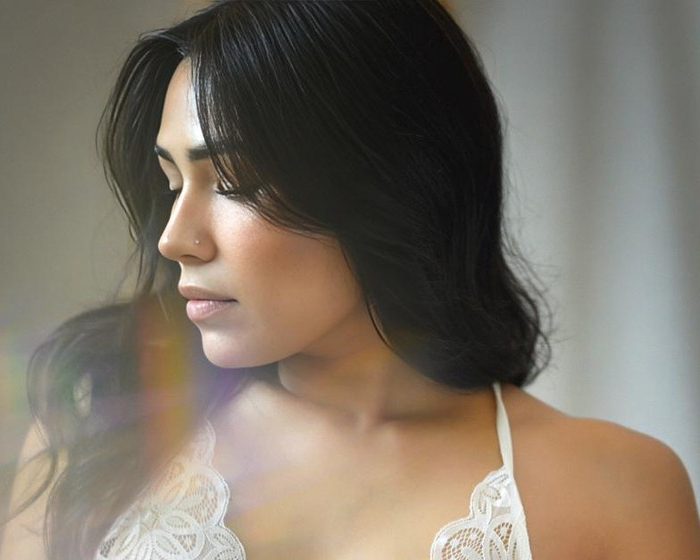
Prism photography is an in-camera technique. You hold a piece of glass or crystal in front of the lens, and it bends, splits and reflects light before that light reaches the sensor. The rainbows, haze, ghosted reflections and geometric light you see are made at the moment of capture, not added in Photoshop.
I've shot boudoir and fine art portraits for more than thirty years, and for the last two I've shot almost everything through handheld glass. This page is the short version of what I've learned: what a prism actually does, whether prism lenses work, which prisms are worth owning, and how to use one on a real shoot.
What is a prism in photography?
A prism is any clear, polished piece of glass or crystal with flat or curved faces that redirect light. Hold one between your lens and your subject and three things happen, usually at once:
- Dispersion. White light splits into its colors because each wavelength bends at a slightly different angle. That's where the rainbow streaks and spectral flares come from.
- Reflection. Light bounces off the inside faces of the glass and lands back in the frame, giving you mirrored or doubled versions of the scene: a second skyline, a ghosted shoulder, a repeated window.
- Refraction blur. The part of the frame seen through the glass is pushed out of focus, so it reads as a soft veil or haze over the image.

What makes it photography rather than a filter effect is control. The same piece of glass gives you a whisper of color or a frame full of geometry, depending on where you hold it, how far it sits from the lens, how you rotate it, where the light comes from and what aperture you shoot at.
Do prism lenses actually work?
Yes. The light really does bend, split and reflect, so the effect is real and it's in the raw file. The better question is which kind of prism you mean, because there are two very different tools sold under that name.
Screw-on prism filters
These mount on the front of the lens like any other filter. They're consistent and easy, and that's the problem: the glass is fixed, so every frame shows the same pattern in the same place. After a dozen shots your work looks like the filter, not like you.
Handheld prisms
A handheld prism is a loose piece of glass you hold in front of the lens. You decide where it enters the frame, how much it covers and which way it throws the light, and you can change all of that between frames. It's harder at first and far more rewarding, and it's the only approach I teach.

What are the four types of prisms?
In optics, prisms fall into four families, grouped by what they do to light:
- Dispersive prisms split white light into a spectrum. The classic triangular prism is one, and it's the source of most rainbow effects in photography.
- Reflective prisms bounce light to change its direction or flip the image. The pentaprism in a DSLR viewfinder and the prisms inside binoculars are reflective prisms.
- Polarizing prisms separate light by its polarization. They're lab and instrument parts, not something you'd hold in front of a lens.
- Beam-splitting prisms divide one beam of light into two. They're found inside cameras, projectors and scientific equipment.
When you hold real glass in front of a lens, you're mostly using the first two behaviors: dispersion for color, reflection for doubling and mirroring.
The four prisms photographers actually use
- Triangular prism. The workhorse. Strong rainbow dispersion, clean reflections and one long edge you can slide into the frame. If you buy one prism, buy this one: a five- to six-inch glass or crystal triangle.
- Crystal sphere. A clear ball that shows the scene upside down inside it and bends light around its curved edge into a soft halo. It's good for framing a subject inside a ring of light.
- Faceted crystal. Chandelier-style cuts that scatter many small spectral highlights and fragments across the frame. A little goes a long way.
- Prism bar. A longer bar of glass with a long edge that's easy to manage. It's good for broad, even reflections and streaks across one side of the image.
A few irregular pieces of clear glass round out a kit. Skip novelty kits and screw-on filters.
How to use a prism for photography, step by step
Start with strong, directional light: a window with sun coming through, low afternoon sun outdoors, a hard strobe or a practical lamp. A prism can only bend the light that reaches it, so flat overcast light gives you very little. A 50mm to 85mm lens with a fast aperture is the easiest place to start, because a longer lens and a wide aperture melt the glass into soft color instead of hard edges.
Then work through the same sequence every time. This is the Prism Control Model™, the framework at the center of my Technical Guide:
- Lock the base exposure. Get the skin midtones right before glass touches the frame. Skipping this is the number one reason prism shots fall apart in post.
- Decide the hierarchy. Choose what stays sharp, what blurs and where the eye lands before the prism is in your hand.
- Add geometry slowly. Bring the prism in from the edge of the frame, close to the lens, and refine in micro-rotations of two to four degrees. Read the histogram, not the glow on the LCD.
- Confirm eye sharpness. Every rotation shifts the optical path, so check that your focus point is still on the eye.
- Change ISO before aperture. Aperture changes depth and flare character at the same time. ISO is the cleaner dial when you only want to manage brightness.
- Shoot across three aperture zones. Dream, Sweet Spot and Structured Geometry give you three different feels from one setup. Give the client all three.

Mistakes that ruin prism shots
- Flare across the eyes. Let color wash over hair, shoulders and background, and keep the eyes clean unless you're doing it on purpose.
- Too much glass. Covering the whole frame turns a portrait into a smear. Enter from one edge and stop early.
- Trusting the LCD. Prism light looks brighter and more saturated on the back of the camera than it is in the file. Check the histogram.
- Fingerprints. A smudged prism gives you mush instead of color. Clean the glass before every set.
- Hunting for the effect mid-shoot. Decide the look first, then place the glass. Rotating at random until something happens is how you end up with what I call accidents: a few keepers and a lot of luck.
More questions
Is prism photography done in Photoshop?
Not the way I teach it. Every prism effect on this page was shot through real glass in front of the lens. Editing is normal color and exposure work; the prism effects are in the original file.
Can I do prism photography with a phone?
Yes. Hold the prism close to the phone's lens and use the telephoto lens or portrait mode if you have them. Phones keep more of the scene in focus, so the glass shows harder edges than it does on a camera with a fast lens.
What prism should a beginner buy?
A single five- to six-inch triangular prism in glass or crystal. Learn it properly before you add a sphere or faceted pieces.
Is prism photography only for boudoir?
No. My work leans boudoir, but the same control applies to weddings, portraits, editorial and product work. Light is light.
Infinite Prisms: the Technical Guide
This page is the overview. The Technical Guide is the full system: 17 chapters and 70 pages on gear and optics, the three aperture zones, color, failure patterns, composition with refraction and the complete Prism Control Model™. It's paired with a 66-page portfolio of work shot entirely through handheld glass.

Michael J. Laudini is a boudoir and fine art photographer with more than thirty years of experience and a BA in Studio Art with an emphasis in photography from Loyola University Chicago. His work has been published in Playboy, VIGOR, HiLife, Marika, DOMINANTE and Boudoir Inspiration. He created the Prism Control Model™ and wrote Infinite Prisms, published by Voluptuary Media, LLC.